How to Get Cited by AI Search, Not Just Ranked
Answer engines quote sources, they don't list links. Here's how to become the page they quote.
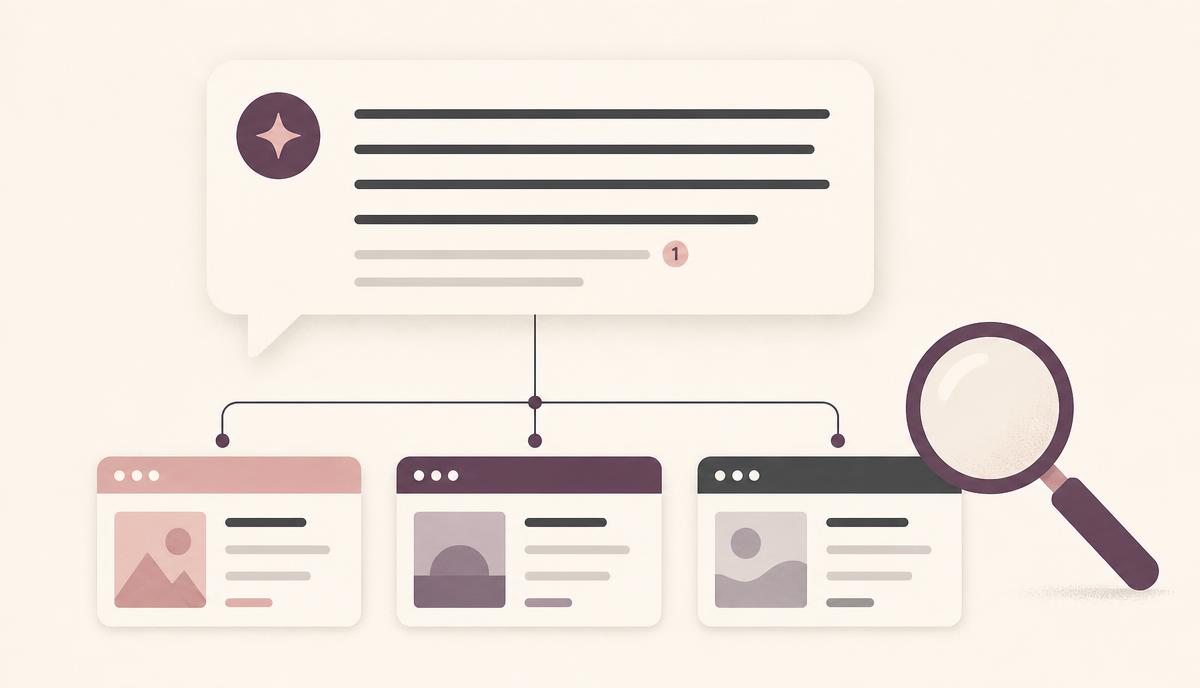
Ranking first used to be the whole game. Now a growing share of searches end inside an answer — ChatGPT, Perplexity, Copilot, or Google's AI Overviews — where the user reads a paragraph and never scrolls a results page. In that world there is no position three. There is only the handful of sources the model chose to quote, and everyone else.
Answer engine optimization (AEO) is the work of becoming one of those sources. The good news: it isn't a separate discipline bolted onto SEO. It's the same foundation, pointed at a different unit of value — the paragraph instead of the page.
What Actually Changes
Classic SEO and AEO share most of their plumbing. Where they diverge is what the engine hands back to the user, and therefore what gets rewarded.
| Classic search | Answer engines | |
|---|---|---|
| What the engine returns | A ranked list of ten blue links | One synthesised answer with a handful of cited sources |
| What wins | Authority, relevance, links, and a page that loads well | A clear, quotable passage that answers the exact question |
| Unit of value | The page | The paragraph |
| How you measure it | Impressions, clicks, positions | Mentions, citations, referral traffic from AI assistants |
Key insight: models don't cite websites, they cite passages. If your best answer is buried in paragraph nine under three paragraphs of throat-clearing, it is effectively invisible — even on a page that ranks well.
Write Answers, Not Introductions
The single highest-leverage change most sites can make is structural. Give every section a question-shaped heading, then answer that question immediately in two or three sentences, in language that stands alone if someone lifts it out. Context, nuance, and examples come after the answer, not before it.
This is the same instinct behind a good featured snippet, and it's why sites that already earn snippets tend to earn AI citations too. The difference is that assistants are far less forgiving of padding. If a model has to reconstruct your answer from four scattered sentences, it will usually quote whoever made it easier.
Be a Verifiable Entity
Assistants weigh who is making a claim, not just what the claim says. That means a named author with credentials, a real About page, and consistent details across your site, LinkedIn, and any directory or publication that mentions you. Schema markup — Person, Organization, Article, and FAQPage — makes those relationships explicit rather than something a crawler has to infer.
Original data helps disproportionately here. A small survey, a benchmark, or a number only you can publish gives a model a reason to name you specifically instead of paraphrasing the consensus.
The Foundation Still Decides
None of this survives a broken technical base. If your content only appears after JavaScript runs, if pages are slow, or if your robots rules quietly block the assistants' crawlers, you are not in the candidate pool at all. That's the argument I made in SEO Isn't Dead. Your Website's Foundation Might Be. — and AI search has only raised the stakes. Speed is part of it too; see how to improve Core Web Vitals without a rebuild.
The AEO Checklist
Work through this in order. Most sites see movement from the first three alone.
- ✓Answer the question in the first 40–60 words of the section, before you add context
- ✓Use question-shaped H2s and H3s that match how people actually ask
- ✓Keep each answer self-contained — assume it will be read out of context
- ✓State facts with concrete numbers, dates, and named sources rather than vague claims
- ✓Add author credentials and a real About page so the entity behind the claim is verifiable
- ✓Mark up content with Article, FAQPage, Person, and Organization schema
- ✓Keep pages crawlable and fast — an unrendered page can't be quoted
- ✓Refresh dates and figures; assistants disproportionately favour recent content
How to Measure Something With No Rank Tracker
There is no Search Console for answer engines yet, so measurement is deliberately scrappy — but it's far from impossible.
- 01Check your robots rulesConfirm you're not blocking the assistants you want to be cited by — GPTBot, PerplexityBot, ClaudeBot, and Google-Extended all respect robots.txt.
- 02Ask the engines directlyRun your top ten commercial questions through ChatGPT, Perplexity, and Google AI Overviews once a month and record who gets cited.
- 03Watch referral trafficFilter analytics for chatgpt.com, perplexity.ai, and copilot.microsoft.com referrals. The volume is small; the intent is unusually high.
- 04Track brand mentions, not just linksAssistants often name a brand without linking. Mentions are the leading indicator that citations will follow.
The Short Version
Getting cited by AI isn't a trick or a new channel to buy into. It's clear answers, placed early, backed by a verifiable author, on a site a crawler can actually read. Do that and you show up in both places — the ranked list and the answer above it.
If you want a read on how quotable your current pages are, I run this as part of an AI search visibility audit. Or just get in touch and tell me which questions you want to own.
© 2026 Cherrelle Davis | SEO Strategist | Google & AI Search Optimization