The Best AI Search Optimization Tools in 2026
You can't improve what you can't see. These are the tool categories that show you how AI search engines read, rank, and cite your brand — and how to pick the right ones.
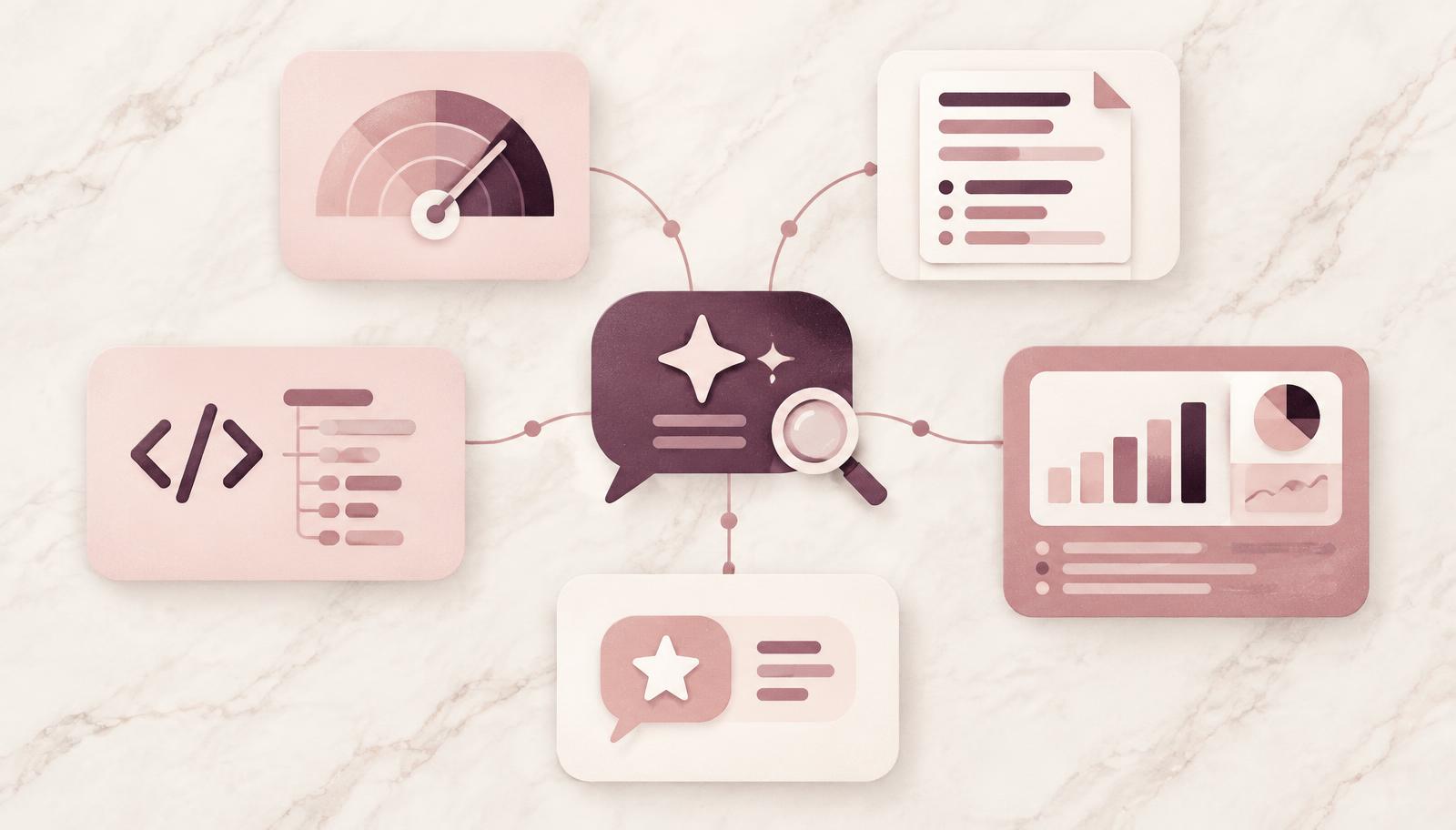
The best AI search optimization tools in 2026 do one thing traditional SEO software never had to: they show you whether ChatGPT, Perplexity, Google's AI Overviews, and Gemini are actually mentioning your brand — and whether those mentions send anyone your way. As answers replace links for a growing share of searches, “am I ranking?” is no longer the whole question. The new question is “am I being cited?” — and you need instrumentation to answer it.
This guide skips the hype and the affiliate-bait rankings. Instead, it breaks AI search optimization tools into the five categories that matter, names real examples in each, and gives you a simple framework for choosing what your business actually needs. Prices and features change fast, so treat specific tools as examples to evaluate, not endorsements.
Why AI Search Tools Suddenly Matter
AI search stopped being a novelty and became a channel. The numbers make the case for measuring it deliberately.
~60%
of US Google queries now surface an AI Overview (reported April 2026)
250–500M
weekly queries flow through ChatGPT Search, one of the top search properties globally (reported 2026)
43.2%
of pages ranking #1 in Google are cited by ChatGPT — roughly 3.5× the rate of pages outside the top 20 (industry study, 2026)
Traditional visibility and AI visibility overlap, but they aren't the same thing — which is exactly why the technical SEO foundation I've written about before matters more than ever, and why you need tools built for this new layer.
Key insight: AI search optimization tools don't replace your SEO stack — they add a missing sense. Your rankings tell you where you stand in a list of links; AI visibility tools tell you whether you exist inside the answer itself.
The 5 Categories of AI Search Optimization Tools
Rather than chase a “top 20 tools” list that's outdated by next quarter, think in categories. Most businesses need one or two of these — not all five.
01AI Visibility & Citation Trackers
These monitor how often your brand appears in AI-generated answers across ChatGPT, Perplexity, Gemini, and Google AI Overviews — your “share of voice” in the answer layer. Examples to evaluate: Profound, Otterly.ai, Peec AI. Start here if you can't yet see whether AI engines mention you at all.
02GEO & Content Optimization Tools
Generative Engine Optimization (GEO) tools analyse your content structure and suggest changes that make it easier for AI systems to extract and cite — clearer answers, better headings, stronger entity signals. Examples to evaluate: the AI-optimization features now built into Semrush and Surfer. Use these when you have visibility data and need to act on it.
03Technical & Schema Tools
AI systems reward clean, structured, crawlable sites. This category covers structured-data (Schema.org) generators and validators, plus Core Web Vitals and crawl tools. Examples to evaluate: Google's Rich Results Test, Schema markup validators, Screaming Frog. Foundational for every business — AI can't cite what it can't parse.
04All-in-One SEO Suites With AI Features
The established platforms have added AI-search modules to their traditional keyword, rank, and backlink tooling. Examples to evaluate: Semrush, Ahrefs, Moz. Best if you want one subscription covering both traditional and AI search rather than stitching point tools together.
05Brand & Reputation Monitoring
Because AI answers synthesise from across the web, what's said about you off-site shapes how you're represented. Mention-tracking and reputation tools help you spot and correct inaccurate or outdated brand information. Examples to evaluate: Brand24, Mention. Valuable once AI engines are citing you and you want to manage accuracy.
Which Category Do You Actually Need?
| If your situation is… | Start with… | Why |
|---|---|---|
| “I have no idea if AI mentions us” | AI visibility & citation trackers | You can't optimise blind |
| “We're mentioned, but not enough” | GEO & content optimization | Restructure content to earn citations |
| “Our site is old / messy” | Technical & schema tools | AI can't cite what it can't parse |
| “I want one tool for everything” | All-in-one SEO suite | Traditional + AI in one place |
| “Wrong info about us is showing up” | Brand & reputation monitoring | Fix the source data AI pulls from |
How to Evaluate Any AI Search Tool
The market is noisy and new tools launch weekly. These criteria cut through it.
“The best AI search tool isn't the one with the longest feature list — it's the one whose data actually changes what you do next week.”
- ✓It tracks the engines your buyers use. ChatGPT, Perplexity, Gemini, and AI Overviews coverage — not just one.
- ✓It measures citations, not just mentions. Being named is good; being linked and driving visits is better.
- ✓It connects to action. Insight you can't act on is a vanity dashboard.
- ✓It shows trends over time. AI visibility moves week to week; a single snapshot tells you little.
- ✓The pricing fits your stage. Don't buy enterprise tooling for a five-page site.
- ✓It complements your existing SEO stack. New layer, not a full rip-and-replace.
A Sensible Starting Stack for Most Service Businesses
You don't need all five categories on day one. A practical, budget-aware starting point:
- 01One visibility tracker to see whether AI engines mention you at all.
- 02One technical/schema tool to make sure your site is parseable and structured.
- 03Your existing SEO suite's AI features before buying anything new — you may already own capability you're not using.
From there, add GEO content tools and reputation monitoring only once the first three surface a clear need. Tools don't create AI visibility — well-structured, trustworthy content does. The software just tells you whether it's working. For the content side, see how to get cited by AI search, not just ranked.
Not Sure Which Tools Are Worth It for Your Business?
I'll help you skip the trial-and-error. Book a free strategy call and we'll map the right AI search setup for your size, budget, and goals.
Book a Free Strategy CallAI Search Optimization · Technical SEO · Content Strategy
Want the strategy behind the tools first? Start with why technical SEO is the foundation of AI visibility, then explore my AI search optimization services when you're ready to put it into practice.
Sources & Further Reading
- Semrush, 26 AI SEO Statistics for 2026 + Insights They Reveal — semrush.com
- BrightEdge / industry reports, AI Overviews Query Coverage, 2026 — brightedge.com
- OpenAI, ChatGPT Search usage figures, 2026 — openai.com
- Google, Search Central — Structured Data & AI Features Documentation, 2026 — developers.google.com/search
- Pew Research, AI Search Behavior Study, 2025 — pewresearch.org
- Cherrelle Davis, SEO Isn't Dead. Your Website's Foundation Might Be. — /blog/seo-isnt-dead
© 2026 Cherrelle Davis | SEO Strategist | Google & AI Search Optimization